Building a Connected Boating App: Engineering Lessons
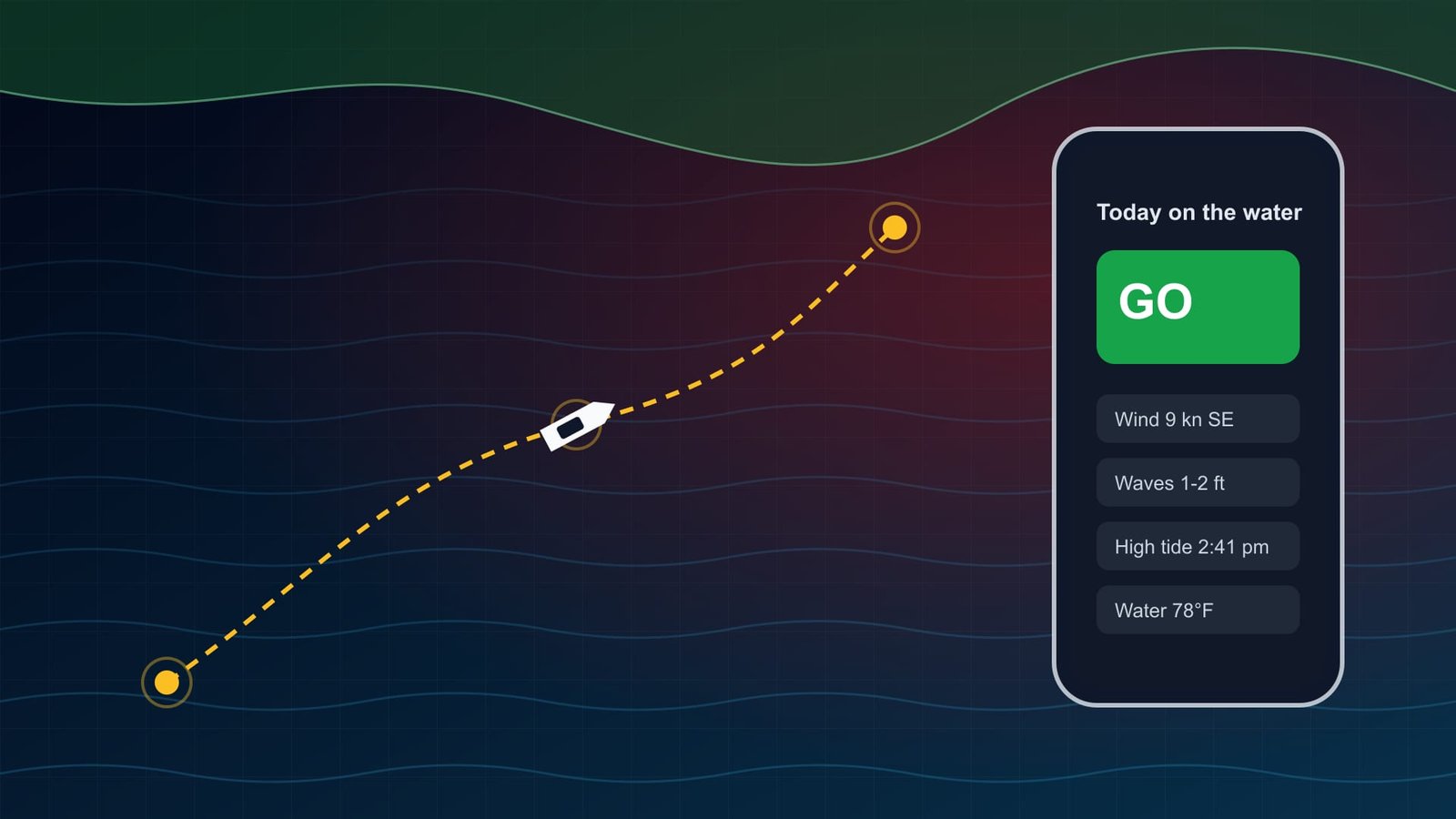
The hard parts of a connected boating app are not the screens. They are five pieces of engineering: turning NOAA and National Weather Service marine data into a go/no-go recommendation people trust, float plans with overdue alerts that fire even when the phone is dead, position tracking that survives no cell signal, an AI assistant that answers only from the boat's own manuals and cites them, and a marketplace side where marinas take bookings. Get those right and the rest is a normal mobile app.
We learned this building the iOS and Android apps, backend, AI assistant and marina portal for a US marine-tech startup's companion app for recreational boat owners, currently in beta. The client and product stay unnamed under NDA, but the lessons apply to anyone building for boaters, marinas, charter operators or marine OEMs.
TL;DR
Treat marine data as messy and sometimes stale, and say so in the UI. Make go/no-go logic transparent rules, not a black box. Run overdue timers on the server. Store-and-forward every position. Ground the assistant in the user's specific manuals with page citations, and let it say "I don't know". On the marketplace side, model slips by boat dimensions and prevent double bookings at the database level.
Which data sources does a US boating app need for weather and water conditions?
Most of what US boaters need is published for free by NOAA. The work is in combining it:
- National Weather Service API (api.weather.gov) - active watches, warnings and advisories, including marine ones such as Small Craft Advisories and Gale Warnings, plus forecasts.
- NWS marine zone forecasts - coastal, offshore and Great Lakes forecasts issued per marine zone. Much of this is still structured text, so you need a parser and a map of the zone polygons to know which forecast applies where the boat is going.
- National Data Buoy Center (NDBC) - measured wind, gusts, wave height, dominant wave period and water temperature from buoys and coastal stations.
- NOAA Tides and Currents (CO-OPS) - observed water levels, tide predictions and current predictions, which matter most at inlets, bars and shallow channels.
What we learned about marine data
- Forecast and observation are different things. Show both: "forecast 10-15 knots, buoy 6 miles out is reading 18". Boaters trust the app more when they can see why it disagrees with itself.
- Data goes stale and stations go offline. Every value needs a timestamp in the UI and a staleness rule in the logic. A buoy reading from five hours ago should not drive a "go".
- Cache aggressively and identify yourself. The NWS API asks clients to send an identifying User-Agent, and it is not designed for every phone to hit it directly. Fetch and normalise on your backend, cache per zone and station, and push to devices.
- Coverage is US-only. NOAA data covers US waters. If you plan to support the Bahamas or Canada, decide early which commercial provider fills the gap so the data model does not assume NOAA everywhere.
How do you build go/no-go logic that boaters actually trust?
Use transparent rules, not machine learning. Boaters - and your lawyers - need to understand why the app said what it said. A rules engine that combines a few inputs and explains its result beats a clever model nobody can audit.
Inputs
- The boat: length, hull type and how it handles a sea - a 20-foot bowrider and a 40-foot trawler have very different limits.
- The captain's own limits: wind, gusts and wave thresholds the owner sets for themselves, with sensible conservative defaults.
- Official advisories for the marine zones along the planned route.
- Forecast and observed conditions: sustained wind, gusts, wave height and wave period. Short-period waves are much rougher than the same height at a long period.
- Context: daylight remaining at the expected return time, and tide or current at any inlet on the route.
Outputs
Three states - go, caution, no-go - each with the reasons listed in plain language: "Small Craft Advisory in effect for your route until 6 pm", "gusts forecast above your 20-knot limit after 2 pm". When key data is missing, fall back to caution rather than go.
Guardrails
- Say clearly, on the screen, that the captain makes the decision. The app is a second opinion, not a permit.
- Log the inputs and rule version behind every recommendation, so you can reconstruct any result later.
- Test the rules against real historical days with your domain experts - including days when conditions changed fast.
How should float plans and overdue alerts work?
A float plan tells someone on shore where you are going and when you will be back - the US Coast Guard has long recommended leaving one with a trusted person. An app makes this easy to file and, more importantly, can notice when you do not come back.
Model it as a state machine
A plan moves through clear states: planned → underway → due → grace period → overdue → contacts notified → resolved. Every transition is an event with a timestamp. The boater can check in, extend the return time or close the plan from the phone at any point, and each of those actions must be idempotent - a check-in sent twice over a flaky connection should not do anything strange.
Run the timers on the server
This is the most important lesson in the whole project. The overdue timer must live on the backend, not on the phone. When something goes wrong at sea, the phone is the thing most likely to be wet, dead or out of signal. The server knows the expected return time and fires the alert whether or not it ever hears from the device again.
Notify people, not authorities
When a plan goes overdue, the app sends the emergency contacts the float plan, the vessel description, who is aboard and the last known position, by push notification and SMS so contacts without the app are still reached. The contact decides whether to call the Coast Guard. Automatically calling emergency services on a missed check-in creates false alarms and is not the app's decision to make. A manual SOS shortcut that connects the owner to the Coast Guard or a towing service is different: a person chooses to use it.
Design for false alarms
Most overdue alerts will be people who forgot to check in at the dock. Make extending and closing a plan one tap, remind the boater before the deadline, and give contacts a clear "they're fine, close this" action. If alerts cry wolf, people stop setting them up. Build a way to fast-forward time in test environments - you cannot QA a six-hour grace period in real time.
How do you track a boat when there's no cell signal?
Store and forward. Record every position locally on the phone, queue it, and upload in batches whenever a connection appears. Never assume a live connection on the water - coverage drops a few miles offshore and in many lakes and rivers.
- Adaptive sampling. Record often when the boat is moving fast, rarely when it is drifting or at anchor. This saves battery and storage without losing the track.
- Platform rules. Background location on iOS needs the right permission and a clear explanation to the user. On Android, long-running tracking needs a foreground service with a visible notification. Budget time for both stores' review processes.
- Send the latest position first. When a connection comes back, upload the most recent fix before the backlog. That is the one an overdue alert needs.
- Tie it to the float plan. The track and the last known position belong to the plan, so contacts see them when an alert fires.
- Battery honesty. Show the user what tracking costs in battery and let them choose the sampling rate.
Phones are not satellite beacons. Be explicit in the app that a phone is not a replacement for a VHF radio, an EPIRB or a personal locator beacon.
How do you build an AI assistant grounded in boat manuals?
Owners constantly ask questions their manuals already answer: what the blinking alarm on the engine panel means, the recommended oil, the winterisation steps for their outboard. A retrieval-augmented generation (RAG) assistant can answer them - if it is built to stay inside its sources. The boat's manuals come first; the owner's service history and the current forecast are useful extra sources for questions like "when is my next service due?" or "is tomorrow morning better?".
- Ingest the right manuals. Owner's manuals for the hull, engines and electronics, parsed with their tables and section structure intact. Check that you have the right to use each document - licensed from the manufacturer or uploaded by the owner.
- Chunk by section and keep page numbers. Every chunk carries make, model, year range, section title and page. Without page numbers you cannot cite.
- Filter by the user's boat. Retrieval only searches manuals for the equipment in the user's boat profile. Answering a question about one engine model with another model's manual is worse than not answering.
- Cite every answer. The response links to the manual and page it came from, so the owner can check.
- Allow "I don't know". If retrieval finds nothing relevant, the assistant says so. For anything safety-critical - fuel systems, electrical faults, steering - it points to the manual and a qualified marine technician rather than improvising.
- Evaluate continuously. Keep a test set of real owner questions with expected sources, and run it on every prompt or model change.
The assistant needs a connection, so cache recent answers and the key manual sections the user has opened, and say clearly when it is offline.
What changes when you add a marketplace and marina booking?
The marina side turns a consumer app into a two-sided product, and it brings its own problems.
- Model slips by dimension. A slip fits a boat by length overall, beam and draft, not just "one slip". Availability search has to filter on all three.
- Prevent double bookings in the database. Use transactions and constraints on overlapping date ranges for the same slip, plus short holds while a boater pays. Checking availability in application code alone fails under concurrent requests.
- Use a marketplace payments product. Split payments and payouts to many marinas, with their own onboarding and tax details, are a solved problem - do not build them yourself.
- Write the weather cancellation policy into the product. Marinas and boaters both need to know what happens when the forecast turns. Keep this a marina policy, not an automatic consequence of your go/no-go logic.
- Make onboarding easy for small marinas. Many still run on phone calls and spreadsheets. A simple dashboard for slips, rates, availability and bookings matters more than an API, though larger operators will want integrations with their existing marina management software.
What would we do the same way again?
- Normalise all external marine data on the backend from day one.
- Treat safety-adjacent features - go/no-go, float plans, alerts - as their own module with stricter review, tests and logging than the rest of the app.
- Write the copy for safety features with the same care as the code. "Caution" with a clear reason is more useful than a red screen.
- Test on the water. Simulators do not reproduce a phone in a dry bag losing signal behind an island.
For the project itself, read the connected boating app case study. For the wider picture of what we build for this sector, see our marine and boating technology page.
Building for boaters or marinas?
Tell us what you are planning and we will walk you through the parts that usually take longest.
Book a scoping call →Frequently asked questions about building a boating app
Where does a boating app get marine weather data in the US?
Mostly from free NOAA sources: the National Weather Service API for watches, warnings and advisories (including Small Craft Advisories), NWS marine zone forecasts for coastal and offshore waters, National Data Buoy Center observations for measured wind and waves, and NOAA Tides and Currents for water levels, tide predictions and currents. Commercial weather providers can add global coverage and higher-resolution models on top.
Can an app tell a boater whether it is safe to go out?
It can give a well-reasoned recommendation, not a guarantee. A good go/no-go feature combines official advisories, forecast and observed wind and waves, and the owner's own limits for their boat, then shows a clear go, caution or no-go state with the reasons behind it. The captain always makes the final call, and the app should say so.
How do overdue alerts work in a float plan app?
The boater files a float plan with the route, people aboard and expected return time. If they have not checked in or extended the plan by that time plus a grace period, the server - not the phone, which may be dead or out of signal - notifies the emergency contacts with the plan and the last known position. The contacts decide whether to call the Coast Guard.
How do you track a boat when there is no cell coverage?
Record positions on the phone, store them locally, and upload them in batches whenever a connection appears. Sample less often when the boat is slow or stationary to save battery, and send the latest position as a priority so overdue alerts always have the most recent location available.
How do you stop an AI boating assistant from making things up?
Ground it in the manuals for the user's actual boat, engine and electronics, retrieve passages filtered by that equipment, and require every answer to cite the manual and page it came from. If nothing relevant is retrieved, the assistant should say it does not know and point to the manual or a qualified technician, especially for anything safety-critical.
Last updated November 19, 2026. Related: connected boating app case study · marine and boating technology.
Did this help?
Nikola Crnogorac, Founder, TekPiq
Ready to build your next project?
Let's discuss how TekPiq can help you ship software that actually moves the needle.